Filip Vaníček and Jakub Klement
Wednesday, April 17, 2013
Monday, April 8, 2013
Friday, April 5, 2013
Symbolism
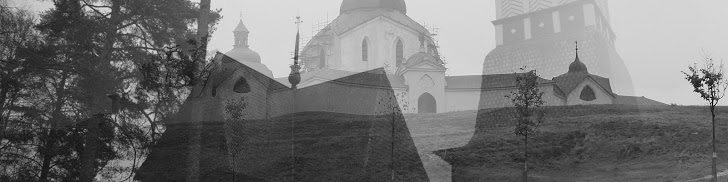
Symbolic elements of the church were already admired in history. The basic principle is the composition of the five-pointed star.
Daniel Jirman
Five-pointed star
Where can we find the symbol?What does five-pointed star mean?
What does legend says about the symbol?
Tongue
Where can we find the tongue?
What does the symbol of ball mean?
Ball with five stars
Where can we find the symbol?
What does symbol mean?
Entrance
Where can we find the symbol?
What does statues mean?
What does legend says about the entrance?
Václav Vejmluva
Václav Vejmluva was born in 1670. When he was 18 he left his family, who owned a brewery in Brno and came to Žďár. However the same year the church in Žďár burnt and it was not possible to live there, so Václav went to Western Bohemia. After moving here he started to study in Prague and in 1695 he became a priest.
When he came back to Žďár after studying in Prague, the church was renovated by a new abbot Edmund Wagner. At the beginning Vejmluva worked there as an economist and then helped to abbot.
In 1705 the abbot Wagner died, Vejmluva became a new abbot , he was confirmed by the Emperor.
The following years of Vejmluva’s life were dedicated to the unceasing care of the economic and spiritual development of the monastery.
After a few years Vaclav met a young architect Jan Blažej Santini-Aichel. In this time there were formed magnificent buildings, some of the buldings have been preserved up to now. The pilgrimage Church of St. John of Nepomuk on the Green Hill is rightly considered the most remarkable building designed by Santini.
In 1737 the monastery set on fire and the fire burnt a large part of the library. The fire had a huge tragic impact on sixty-seven-year-old abbot Vejmluva. The old man didn’t manage to cope with the horrible accident and three days after the fire he died.
Eva Fousová
When he came back to Žďár after studying in Prague, the church was renovated by a new abbot Edmund Wagner. At the beginning Vejmluva worked there as an economist and then helped to abbot.
In 1705 the abbot Wagner died, Vejmluva became a new abbot , he was confirmed by the Emperor.
The following years of Vejmluva’s life were dedicated to the unceasing care of the economic and spiritual development of the monastery.
After a few years Vaclav met a young architect Jan Blažej Santini-Aichel. In this time there were formed magnificent buildings, some of the buldings have been preserved up to now. The pilgrimage Church of St. John of Nepomuk on the Green Hill is rightly considered the most remarkable building designed by Santini.
In 1737 the monastery set on fire and the fire burnt a large part of the library. The fire had a huge tragic impact on sixty-seven-year-old abbot Vejmluva. The old man didn’t manage to cope with the horrible accident and three days after the fire he died.
Eva Fousová
Jan Blažej Santini Aichel (3. 2. 1677 – 7. 12. 1723)
Jan Blažej Santini Aichel was one of the most famous architects and painters in his period. He was born on 3th February 1677 in Prague as the oldest son of a stone artist. His family supposed that young Santini will continue in the same craft as his father, but he was more interested in art, so his dad helped him to realise his dreams to be an architect. We don't correctly know who was Santini's teacher of art, but it may be Jean Baptista Mathey and Jean Schröder. He travelled around Italy and Austria where he had an oppurtunity to take some experiences, especially of a radical architect Francesco Boromini.
In 1700 Santini kept his own building company and he could start project monuments. He got unfinished projects by J. B. Matheye after his death and he finished them. He met Wolfgang Lochner who was the first important customer for him a few years later. After this meeting he received lots of contacts to other customers especially abbots of Cistercian monasteries who fancied Aichel's work. Abbots were the most interested people of Santini's work. He worked for abbot Jindřich Snopek from Sedleč, abbot Evžen Tyll for whom Santini built Plasy, for abbot Václav Vejmluva for whom he projected the church on the Green Hill in Žďár nad Sázavou.
He got married Veronika Alžběta, a daughter of Schröder in 1707, in the year when his teacher of art Schröder already died. They had 4 children, but 3 of them (all boys) died as children and only his daughter Anna Veronika survived. In 1720 his wife Veronika died too, so his personal life was not as easy as we could think. These sad events did not break his personality and he got married again and approached to an aristocratic family one year later and started really a new life.
Information about Santini are not clear enough.
Perhaps about 60 monuments were designed and built by him and ten of them are well – known master pieces. I want to mention some of his projects - it is the reconstruction of the gothic cathedral in Sedlec, the project of a church in Křtiny which was not realised exactly according to his plans, project of castle Charles Crown in Chlumec nad Cidlinou or the most famous project of the church on the Green Hill.
Santini was humble during his life so we cannot be suprised that his tomb is not in a famous cemetery, but it is in a small church of St. Jan in Prague. This succesful architect will never be forgettable because his monuments will show us his work for long times and especially his baroque -gothic style is unbelievely monumetal for us nowadays.
Wednesday, March 20, 2013
Way of the cross for young people
On Saturday, 9th March 2013, there was way of the cross for
young people on Green Hill. Way of the cross is a very specific Christian
tradition. Christians remind themselves the death of Jesus, who died on the
cross before Easter. One person brings the cross and the others bring candles
and pray. There are 14 stations, at every station there is a short speech and
then everybody is thinking about his or
her mind for a while. There are different ways how to organize it. We started
in the Basilica Minor and continued around the hill to the Church of st. John
Nepomuk. We stopped at different places and that was one station. It was rainy
and cold but we stayed until the end. There were 31 people from Žďár and its neighborhood. Everybody was glad he came despite the bad
weather, because it was nice spiritual experience.
Míša Mužátková
Subscribe to:
Posts (Atom)