Friday, April 5, 2013

Jan Blažej Santini Aichel (3. 2. 1677 – 7. 12. 1723)


Jan Blažej Santini Aichel was one of the most famous architects and painters in his period. He was born on 3th February 1677 in Prague as the oldest son of a stone artist. His family supposed that young Santini will continue in the same craft as his father, but he was more interested in art, so his dad helped him to realise his dreams to be an architect. We don't correctly know who was Santini's teacher of art, but it may be Jean Baptista Mathey and Jean Schröder. He travelled around Italy and Austria where he had an oppurtunity to take some experiences, especially of a radical architect Francesco Boromini. 

In 1700 Santini kept his own building company and he could start project monuments. He got unfinished projects by J. B. Matheye after his death and he finished them. He met Wolfgang Lochner who was the first important customer for him a few years later. After this meeting he received lots of contacts to other customers especially abbots of Cistercian monasteries who fancied Aichel's work. Abbots were the most interested people of Santini's work. He worked for abbot Jindřich Snopek from Sedleč, abbot Evžen Tyll for whom Santini built Plasy, for abbot Václav Vejmluva for whom he projected the church on the Green Hill in Žďár nad Sázavou.

He got married Veronika Alžběta, a daughter of Schröder in 1707, in the year when his teacher of art Schröder already died. They had 4 children, but 3 of them (all boys) died as children and only his daughter Anna Veronika survived. In 1720 his wife Veronika died too, so his personal life was not as easy as we could think. These sad events did not break his personality and he got married again and approached to an aristocratic family one year later and started really a new life.

Information about Santini are not clear enough.

Perhaps about 60 monuments were designed and built by him and ten of them are well – known master pieces. I want to mention some of his projects - it is the reconstruction of the gothic cathedral in Sedlec, the project of a church in Křtiny which was not realised exactly according to his plans, project of castle Charles Crown in Chlumec nad Cidlinou or the most famous project of the church on the Green Hill.

Santini was humble during his life so we cannot be suprised that his tomb is not in a famous cemetery, but it is in a small church of St. Jan in Prague. This succesful architect will never be forgettable because his monuments will show us his work for long times and especially his baroque -gothic style is unbelievely monumetal for us nowadays.

Radka Filipi

Wednesday, March 20, 2013

Way of the cross for young people


On Saturday, 9th March 2013, there was way of the cross for young people on Green Hill. Way of the cross is a very specific Christian tradition. Christians remind themselves the death of Jesus, who died on the cross before Easter. One person brings the cross and the others bring candles and pray. There are 14 stations, at every station there is a short speech and then everybody is thinking  about his or her mind for a while. There are different ways how to organize it. We started in the Basilica Minor and continued around the hill to the Church of st. John Nepomuk. We stopped at different places and that was one station. It was rainy and cold but we stayed until the end. There were 31 people from Žďár and its neighborhood.  Everybody was glad he came despite the bad weather, because it was nice spiritual experience.
Míša Mužátková


Monday, March 4, 2013

The Legend About the Green Hill


Once upon a time there were really bad times for people in Bohemia because the weather was really dry and it had not rained for a long time. The reason of this situation was that the pagan family of Vrsovci had an argument with the bishop Vojtech from the family of Slavnikovci.


Vojtech was the bishop of Prague bishopric and he was very popular among ordinary people from Highlands because of his willingness and reliability. Once he visited the residents of Highlands and they persuaded him to stay with them.


 People were really frightened and they hoped that Vojtech will come back and save them.
On the green hill the old hermit Brimota was living in that time. One day he was visited by Vojtech, who went to Bohemia to save people from the curse. When people learned about his arrival, they all came and asked him for help.


Vojtech agreed and he stood on a stone. He started to


In that time it started to rain and the grass turned green and streams filled with water.
So people started to call this place the Green Hill.


Natálie Zelinková


Why is important to study English?

Simply because we would be able communicate. English is considered to be one of the most important widespread languages and its grammar is not so difficult. Wherever we travel, we can use it. And this is the magic of English. We cannot learn English properly at school by mechanically learning grammar rules to know them by heart. Fluent communication in English is possible when we are forced to speak with somebody who cannot understand our Czech. Our Bishop grammar school has helped me in this way. I could participated in the project of European Union Comenius Bilateral Partnership. Thanks to this project I could visit Finland and I could practice my English for two weeks and work on the team project. It was perfect for me. I stayed in a family where I could speak of course only English and I had to use my knowledge of English from school to complete sentence as good as it was possible. I lost my worries about making mistakes and be lost in a foreign country. My fear was away.
We all make mistakes but we can understand each other!
Thanks to these two weeks my English improved rapidly and I could make new friendships which I developed when my new friends visited our school and Žďár nad Sázavou.


Proč je důležité učit se angličtinu?

Proč je důležité učit se angličtinu? Jednoduše proto, abychom se domluvili. Angličtina patří mezi světové jazyky a její gramatika není zase tolik složitá. Ať pojedeme kamkoli, domluvíme se. A v tom je právě kouzlo angličtiny. Mluvit anglicky se totiž nenaučíme ve škole tím, že budeme znát všechny gramatické poučky nazpaměť. Mluvit anglicky se naučíme, až budeme donuceni mluvit s někým, kdo nám jinak nerozumí. A v tom mi hodně pomohla naše škola. Dala mi možnost zúčastnit se projektu Comenius Partnerství škol. Díky tomuto projektu jsem mohla spolu s dalšími spolužáky odcestovat do Finska a dva týdny mluvit anglicky a pracovat na společném projektu. Byl to pro mě velký přínos. V rodině, kde jsem bydlela, jsem se jinak než anglicky nedomluvila, byla jsem tedy nucena využívat svých znalostí ze školy a skládat věty jak nejlíp to šlo. Ztratila jsem strach z toho, že udělám chybu a celá věta bude špatně, že mi nikdo nebude rozumět. Brzy mi došlo, že můj strach vůbec nebyl oprávněný. Všichni chybujeme, ale i přesto si rozumíme. Díky těmto dvěma týdnům se moje angličtina rozvinula a já měla možnost navázat nová přátelství, která se ještě více utužila, když přijeli naši kamarádi za námi do Žďáru.

28. 2. 2013 Míša Mužátková 


Tuesday, January 29, 2013

Questionnaire


Filip Vaníček and Jakub Klement

History of the Church of St. John of Nepomuk

Why was the monument built? Many people can ask why Santini designed the church on the Green Hill. That is an easy answer but we should go back to the history of the monument.

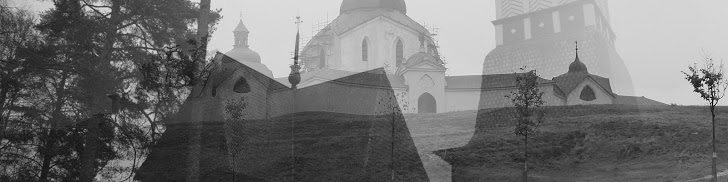
Václav Vejmluva was an abbot of the monastery in Žďár nad Sázavou since 1705. It was discovered in the tomb of John of Nepomuk in St. Vitus Cathedral in Prague. Abbot Vejmluva decided to build an extraordinary church near the monastery. The first question was who would be the architect? His decision was clear - Jan Blažej Santini Aichel was a well - known baroque architect, so Václav Vejmluva chose him to make a project of the monument. In 1719 Santini started to work on the project. Václav Vejmluva introduced him his visions about the form of the church on the Green Hill although he did not accept traditions of religious buildings. However he accepted the structure of a pilgrimage destination. Santini tried to project the church as a star, every symbol of the church he designed in detail.

In summer 1719 Santini started his work on the monument. It was extraordinary in that time. The project could not stop him to realize it, such as measuring area, digging and building bottom walls of the future church. It was difficult to ensure available material and people who were working on the project. The first celebration of the church was when a foundation stone was placed in 1720. The building was constructed in the following year and in 1722 it was consecrated. The cloister was built in 1740 but during next years it was quite changed. After basic works it was neccesary to furnish the church. Santini designed the main altar which is made in details especially with a statue of John of Nepomuk. In the project of the church there were not mentioned any cemetery inside the area of the place where the church was. Santini unfortunatelly died before the completion of the church, so other artists had to complete the building.

The church on the Green Hill became the most visited pilgrimage place and lots of baroque events were organised there. Lots of people from further places visited this spectatular monument not only because of religious events even though because of the impressive beauty of the church.. At the beginnings of its existence there was a big fame of this place. However in 1784 the monastery and the church caught fire. In this time the abbot of monastery in Žďár nad Sázavou was Otto Steinbach from Kranichštejn and he did not want to repair damages after the accident. The monument fell into serious disrepair, the roof was broken and it was neccesary to make decisions to rescue the running of the church. People decided to give some money for repairs. It was not enough, the monastery was cancelled and in the church there were only masses to honour St. John of Nepomuk.

A few years later about in the year 1791 citizens of Žďár nad Sázavou and Nové Město na Moravě demanded repairs of the church. So the bishop Lachenbacher accepted demands and allowed only funerals in the church and he banned masses there. People did not agree with his decision and they wanted to change something. The Bishop was angry and he warned people if they did not agree he would demolish the church. Finally the roof was repaired and lots of repairs were made there. The church needed many repairs and it cost lots of money. People who liked the church invested to this repairs and it really helped to hold this pilgrimage place in nowadays form.

Vratislav from Mitronic became a new owner of the church in 1826. The church was a private property in this age and all decisions about the church were private. Unfortunatelly the owner was responsible not only for the parish church but also for the church on the Green Hill. Fortunatelly the owner fell being responsible for the church. Matěj Sychra was interested in the church on the Green Hill and could influence local authorities to save it. He helped to repair the church and in 1729 the church was consecrated again by him. Next year Sychra died.

The weather in the Highlands is sometimes very cold and it has influenced the building very much. Storms ruined the roof , frost destroyed roof frames, so other repairs were neccesary. In this age Josef from Ditrichštejn and countess Clam-Gallasov gave some money to repair it again. The Church on the Green Hill needed more and more repairs and the state wanted to decide about the future owner of the church.

In 1914 the First World War started and the church started to be less important in comparison with the defence of nation. After the war only windows.were changed. The church started to fall into ruin and next disaster appeared - the Second World War.

In 1953 the state became the new owner of the church and it has been since that time.The government has kept the church in a good state and it has repaired everything which has been neccesary. ( Especially in 70s and 80s of 20 century).

The memory became famous not only in former Czechoslovakia but also abroad and lots of people started to visit it again. In 1994 the church of St. John of Nepomuk was written to the list of UNESCO World Heritage.

Nowadays many people from all around the world know this extraordinary monument.Local people are really proud of this monument and they hope that Santini´s work would be never forgotten.


Radka Filipi


Monday, January 28, 2013

Finnish, English and Czech Christmas

During Christmas class of English Mrs. Stráská prepared for us a little bit of Finish culture and language because she has been the coordinator of the project Comenius with our partner school in Finnish Jyväskylä for two years.

We had the opportunity to get to know something about traditional Finnish Christmas. There is a huge difference between our Czech Christmas and Finnish, especially in meals, sweets and celebrations.

In Finland they have a special "Santa Claus". His name is Joulupukki. He lives in Lapland in the north of Finland. His name consists of two parts. The first part is Joulu and it means Christmas and the second part is from a verb nuuttipukki. Nuuttipukki is one of the old traditions of Finland when people wore clothes from goat skins.It was excited to get to know something from Finnish language, because Czech and English language are completely different from Finnish. We tried to match Finnish and English basic words connected with Christmas. We could listen to the traditional Christmas song Sylvian Joululaulu and look at a beautiful book about Finnish Christmas painted by a famous Finnish painter Mauri Kunnas. Finnish class was a big upgrading of normal English classes. I am sure we will remember this new experience!

Tereza Polednová, Ivana Novotná, I.B a kvinta class

Jitka Stráská

The lesson was prepared for 89 students)